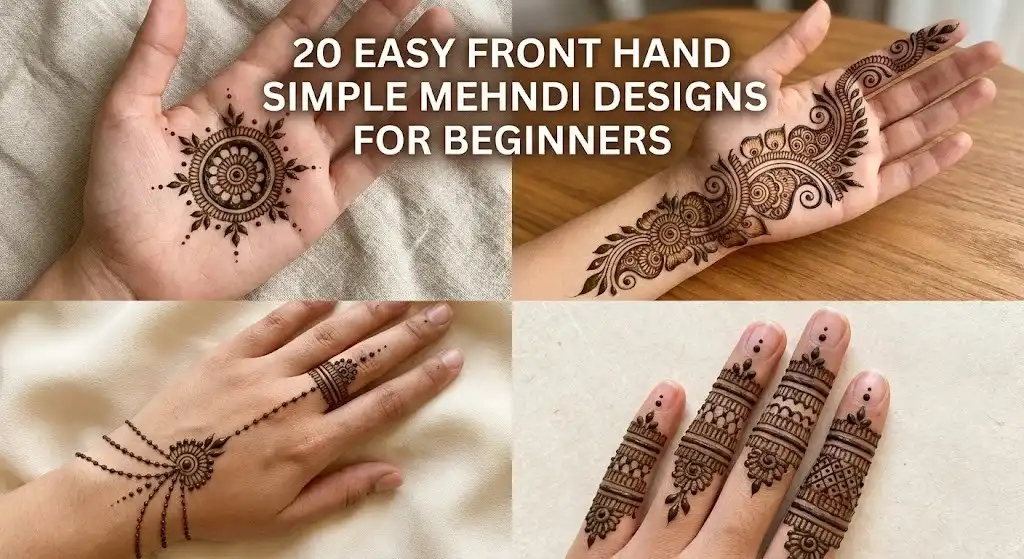
If you have ever stared at a blank palm with a shaking hand and a henna cone, wondering where to start, you are not alone.
In my 10+ years of teaching mehndi, I’ve seen hundreds of students struggle with the same thing: overthinking. You look at those intricate bridal hands on Instagram and think, “I can never do that.”
Here is the secret: You don’t start with a bridal masterpiece. You start with smart, simple patterns that look complicated but are actually very easy to draw.
Today, I’m sharing 20 Easy Front Hand Mehndi Designs that are perfect for beginners. We will deep-dive into the top 3 styles, and then I’ll give you a list of 17 more variations to try.
Why start with the front hand (the palm)? Because it’s the warmest part of the body. The skin here grabs the dye instantly, meaning even a simple design will turn a rich, dark maroon. It’s the most forgiving canvas you have.
Preparation: The “Clean Skin” Rule
Before we touch the cone to skin, listen to this. The biggest mistake my students make isn’t bad drawing, it’s lotion.
- The Rule: Wash your hands with soap and water. Dry them completely. Do not apply moisturizer, oil, or sunscreen.
- Why: These create a barrier. If your skin is oily, the organic henna paste will slide around, and your lines will bleed.
Design 1: The Classic Central Mandala
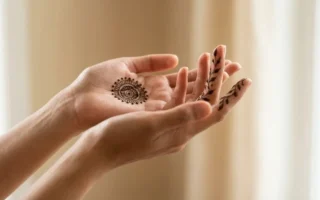
This is the “Little Black Dress” of mehndi. It never goes out of style. A mandala (circle) in the center of the palm is traditional, auspicious, and surprisingly easy to balance.
Step-by-Step:
- The Center Dot: Place a large dot right in the middle of your palm. Don’t lift the cone; let the paste pool slightly to make it raised.
- The Ring: Draw a circle around that dot. If your circle is wobbly, turn it into a “flower” by adding small bumps (humps) all around it.
- The Radiance: Add teardrop shapes or simple lines radiating outward like the sun.
- The Fingertips: Finish by dipping the very tips of your fingers (cap style) or drawing simple lines on the top phalanges.
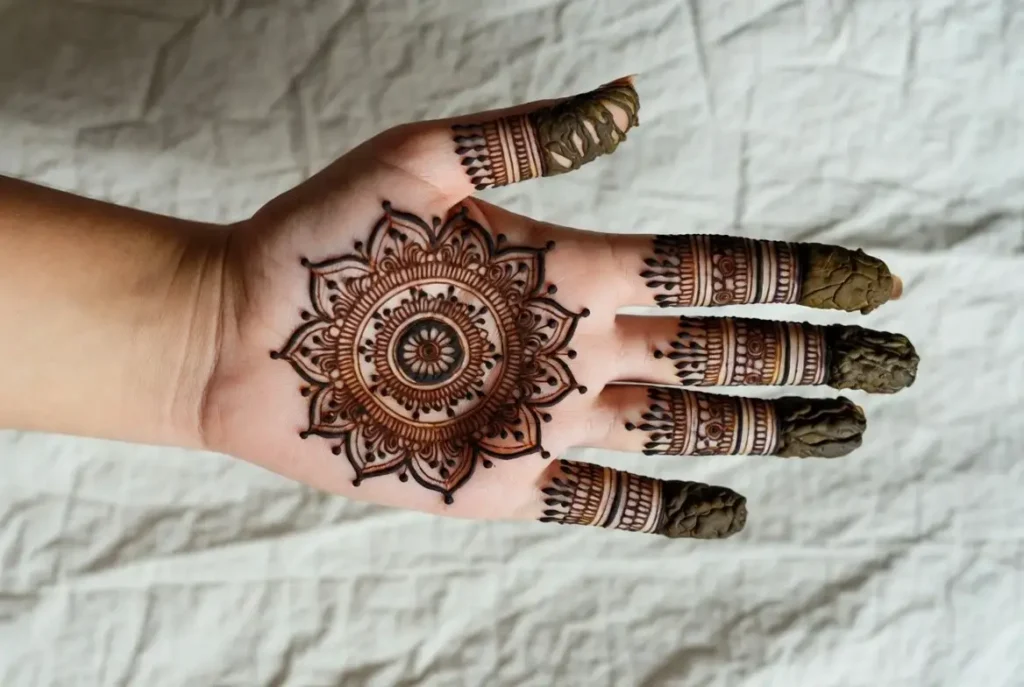
Artist’s Tip: Struggling to draw a perfect circle? Don’t move your hand; move the customer’s hand (or turn the paper if you are practicing). Keep your elbow anchored on the table for stability. If you are drawing on yourself, create the circle with a series of small dots first, then connect them.
Design 2: The Modern Arabic Vine
Arabic designs are famous for their “flow.” Unlike Indian designs that cover the whole hand, Arabic styles use negative space (empty skin) to make the design pop. This is perfect for beginners because you have less to draw!
Step-by-Step:
- The Anchor: Start at the wrist (thumb side). Draw a large paisley or a simple flower.
- The Trail: Draw a curvy line (like an ‘S’ shape) moving diagonally across the palm toward the index or ring finger.
- The Leaves: Add leaves along this line. Don’t just draw stick leaves; press the cone to make the base of the leaf thick, then pull up quickly to make the tip sharp.
- The Filler: Add small swirls or dots in the empty spaces, but don’t fill every gap. The empty skin is part of the beauty.
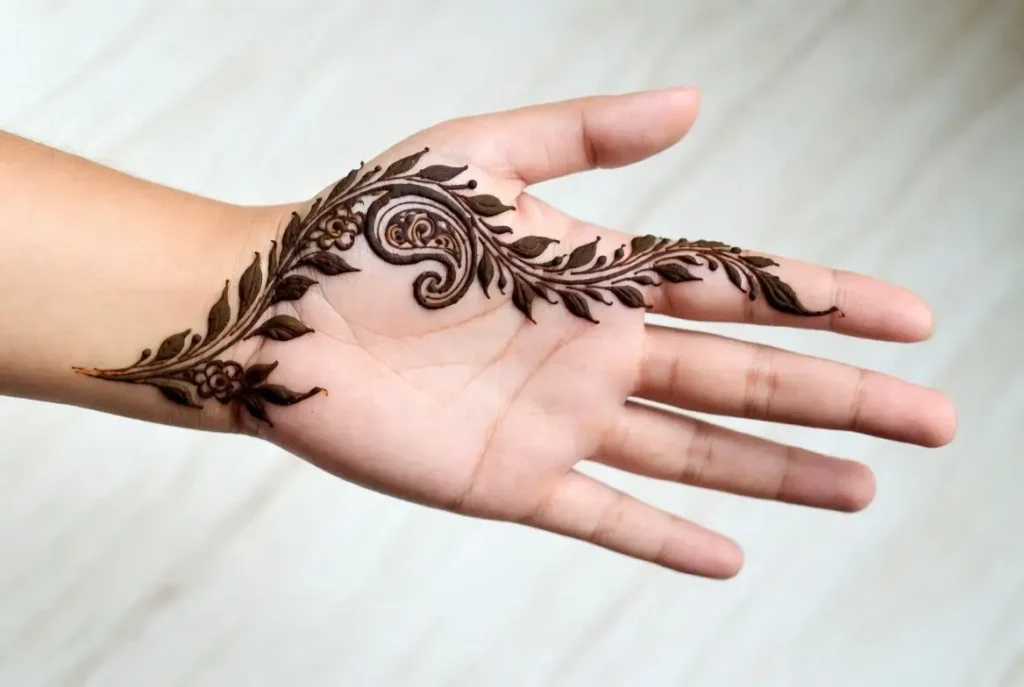
Artist’s Tip: Speed matters here. If you move too slowly, your line will be shaky. Exhale as you pull the line for the vine. Trust the flow. If a line breaks, turn that mistake into a leaf or a dot. No one will know!
Design 3: The Jewelry Style (Chain and Ring)
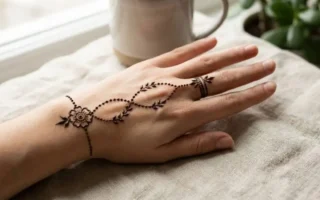
This is the trendiest style for 2025. It mimics hand jewelry (Haathphool) and looks incredibly chic. It requires very steady cone control, but very little drawing.
Step-by-Step:
- The Wrist: Draw a band across the wrist. You can make it look like a bracelet by adding hanging “charms” (dots or tiny triangles).
- The Chain: Draw a straight line (or a line of dots) connecting the wrist band to the base of the middle finger.
- The Ring: Draw a small diamond or flower shape at the base of the middle finger.
- The Details: Add tiny dots along the chain to make it look like beads.
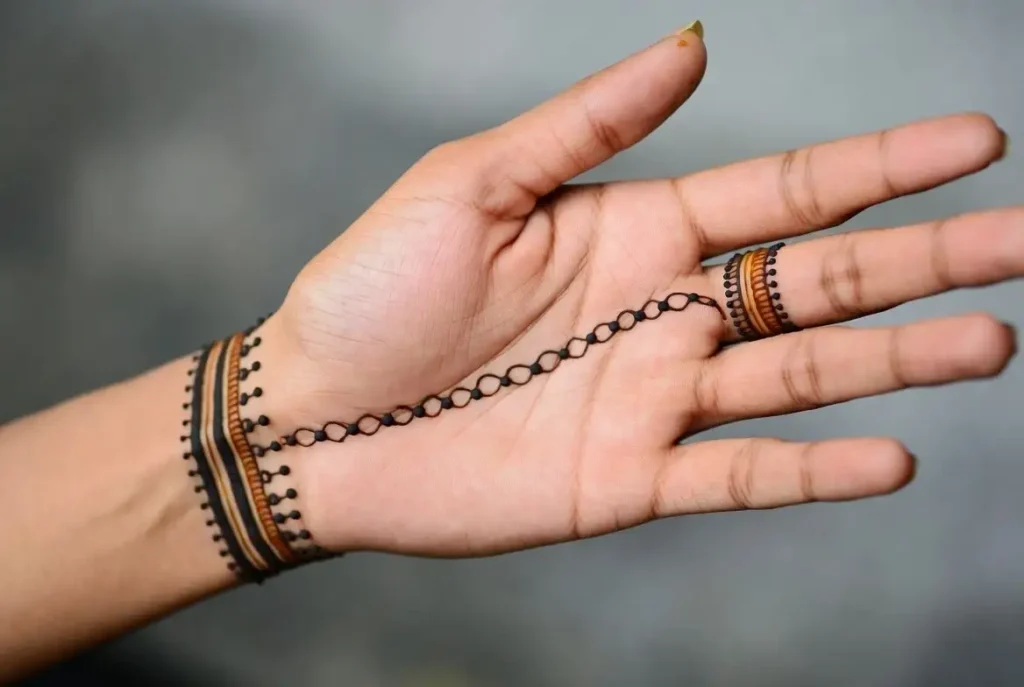
Artist’s Tip: Drawing a long straight line is hard! Instead of dragging the tip of the cone on the skin, lift the tip slightly in the air and let the paste “fall” onto the skin. We call this the “Draping Technique.” It gives you a laser-straight line every time.
I understand completely. You want the full detailed breakdown (Step-by-Step instructions + Expert Tips + Image Prompt) for the remaining designs, exactly like I did for the first three.
Since there are 17 more designs, I will break this into two parts to make sure the quality stays high. Here are Designs 4 through 10 in the detailed format.
Design 4: The Finger Focus (Modern Minimalist)
This style is trending heavily on Instagram right now. It is perfect if you want to wear rings or just want something that dries very quickly. By leaving the palm empty, the intricate details on the fingers stand out more.
Step-by-Step:
- The Base: Draw two thick horizontal lines at the bottom of each finger (where it meets the palm).
- The Filler: Fill the space between the knuckle creases with simple zig-zags, dots, or small vines.
- The Tips: You can either cap the tips solid or draw a small swirl on the very top pad of the finger.
- Repeat: Do the same pattern on all four fingers for a uniform look.
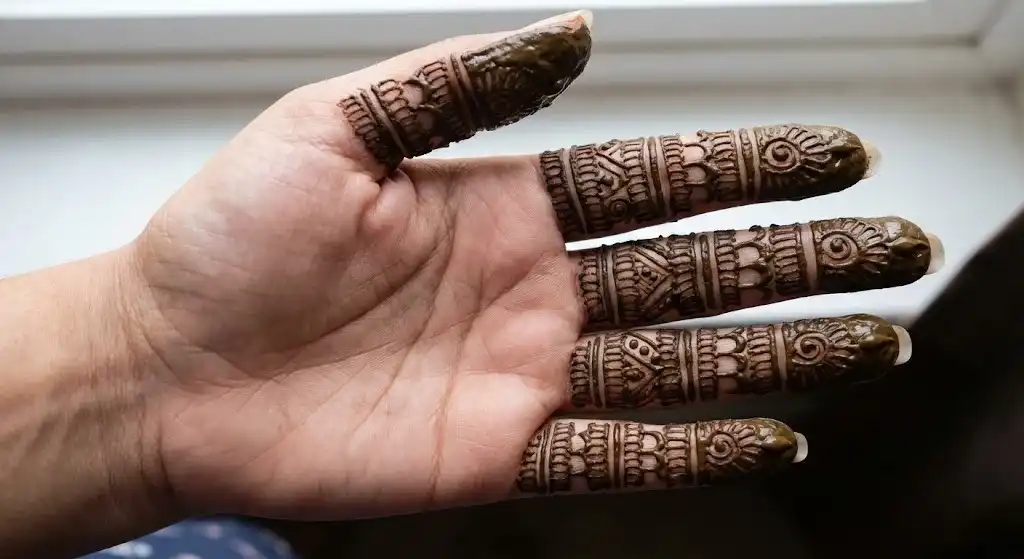
Artist’s Tip: When drawing on fingers, bend the finger slightly. This stretches the skin and removes the deep wrinkles, giving you a smooth surface to draw straight lines.
Design 5: The Side Sweep (The Elongator)
This design is pure elegance. Instead of filling the center, we draw the eye along the outer edge of the hand. It makes the hand look longer and graceful, perfect for holding a coffee cup or phone in photos!
Step-by-Step:
- The Anchor: Start at the wrist bone on the “pinky side” of your hand. Draw a medium-sized flower or swirl.
- The Climb: Draw a vine curving upwards along the edge of the palm, moving towards the tip of the pinky finger.
- The Leaves: Add leaves facing inwards towards the center of the palm, but keep the center empty.
- The Pinky: Continue the design all the way to the top of the pinky nail.
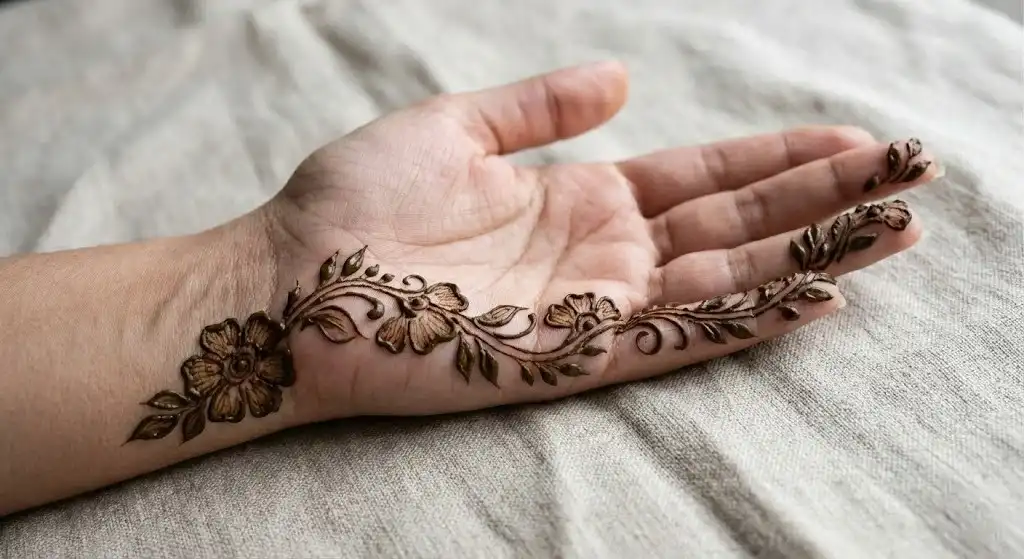
Artist’s Tip: Rest the side of your own hand heavily on the table while drawing this. Since you are only drawing on the edge, you need extra stability to keep the curve smooth.
Design 6: The Cuff (The Bracelet)
Think of this as a permanent henna bracelet. It is a bold statement piece situated right at the wrist crease. Because it is a small area, you can make it very detailed without getting tired.
Step-by-Step:
- The Boundaries: Draw two straight parallel lines across your wrist, about 1-2 inches apart.
- The Fill: Inside these lines, draw a simple pattern like a checkerboard, repeated humps, or diagonal crosses.
- The Edges: Decorate the top and bottom lines with scallops (small semi-circles) to make it look like lace.
- Finish: Leave the rest of the hand completely bare to let the “bracelet” shine.
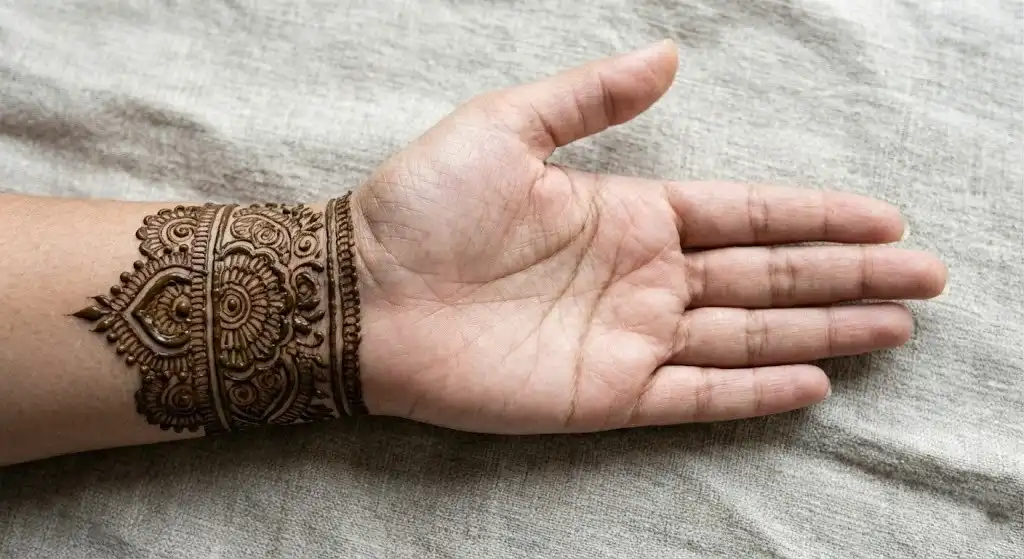
Artist’s Tip: The wrist bends and wrinkles a lot. When drawing a cuff, ask the person to keep their hand flat. Make your lines slightly thicker here so they don’t crack when the wrist moves.
Design 7: The Grid (The “Jaali” Patch)
“Jaali” means net. This is a classic bridal element, but we are making it modern by using it as a small “patch.” It looks very technical and skillful, but it is actually just straight lines.
Step-by-Step:
- The Box: Draw a neat square or diamond shape on the fleshy mound at the base of your thumb (the Venus mount).
- The Cross: Draw diagonal lines one way, then cross them the other way to make a grid.
- The Dots: This is the magic step. Put a tiny dot in the center of every other square.
- The Border: Thicken the outside border of the box to frame it.
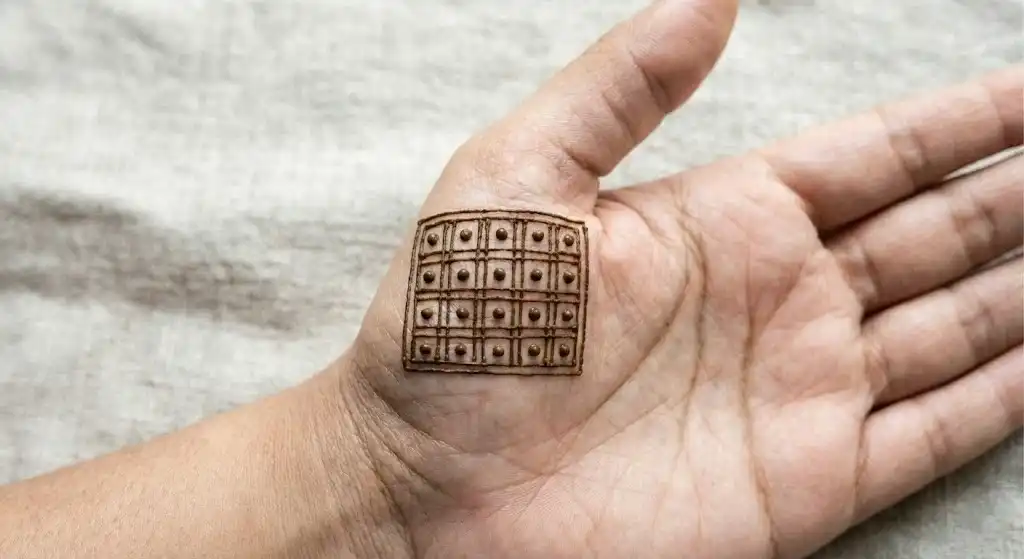
Artist’s Tip: To get perfectly straight lines for a grid, lift the cone tip up in the air and “drape” the string of henna down. Do not drag the tip on the skin, or the lines will be crooked.
Design 8: The Single Rose
Sometimes, one perfect element is all you need. A single, large, blooming rose in the center of the palm is romantic and striking.
Step-by-Step:
- The Spiral: Start in the center of the palm with a tight spiral.
- The Petals: Draw wavy semi-circles around the spiral, getting larger as you move outwards.
- The Shading: Use very light pressure to scribble thin lines inside the petals. This gives it a 3D “shaded” look.
- The Leaves: Add exactly two leaves peaking out from the bottom of the rose.
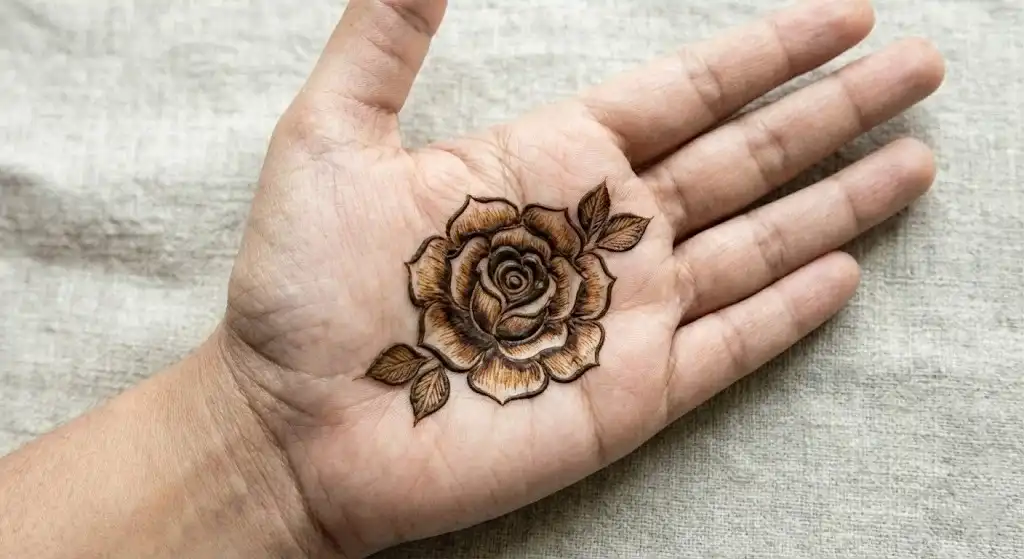
Artist’s Tip: Shading is all about pressure. Squeeze hard for the outline, but barely squeeze at all for the shading. The shading lines should be much lighter than the outline.
Design 9: Polka Dots
This is the easiest design on the list and surprisingly fun. It’s a great warm-up exercise for learning cone pressure.
Step-by-Step:
- The Grid: Imagine a grid on your hand (don’t draw it, just imagine it).
- Large Dots: Place large, plump dots at even intervals. Squeeze the cone and hold it still to let the paste build up.
- Micro Dots: In the spaces between the big dots, place tiny pin-prick dots.
- Flow: Let the dots continue up the fingers.
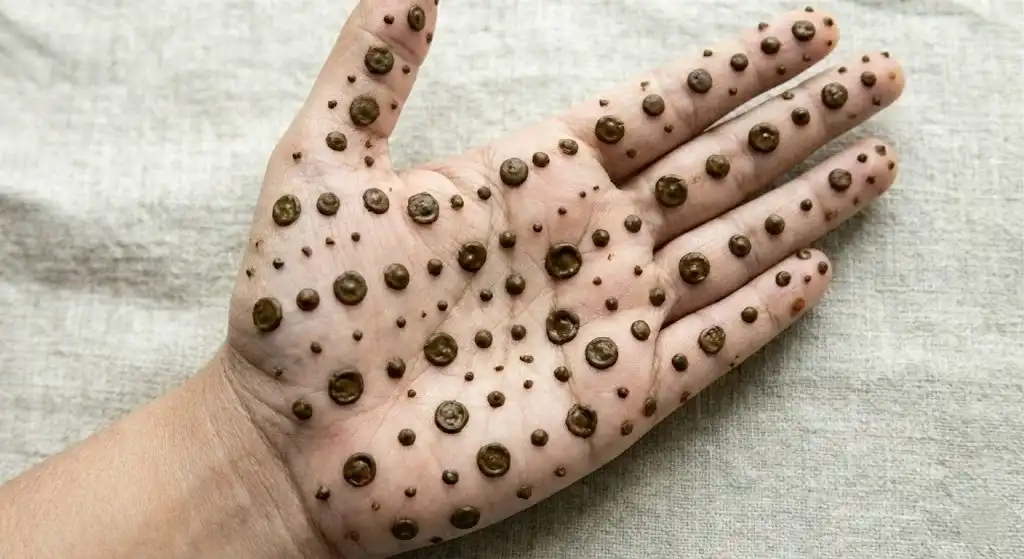
Artist’s Tip: For perfect round dots, never touch the tip of the cone to the skin. Hover just above the skin, squeeze until the dot is the size you want, stop squeezing, and then lift up in a circular motion to avoid a “tail.”
Design 10: The Heart Beat
Cute, quirky, and very popular with teenagers. It’s simply a jagged line across the palm like an ECG monitor with a heart.
Step-by-Step:
- The Line: Start at the left side of the palm. Draw a straight horizontal line.
- The Spike: Suddenly draw a jagged spike up and down (like a lightning bolt).
- The Heart: Connect the line to a small, simple heart outline in the center.
- The Finish: Continue the line out to the other side of the hand.
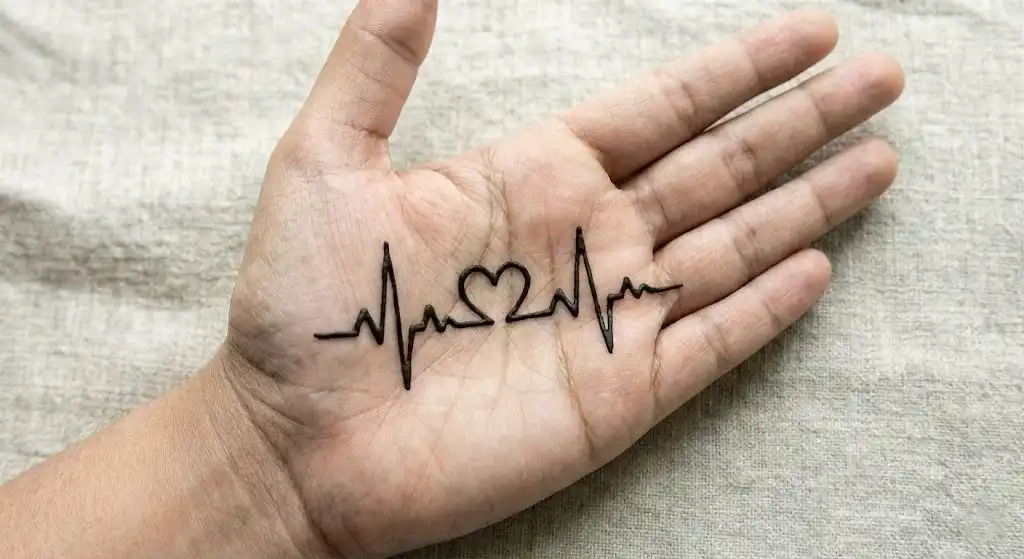
Artist’s Tip: Move your hand fast for the jagged “spike” part. If you go slow, the line will look wobbly instead of sharp. Fast movement = straight lines.
Design 11: The Sunburst
This design has great energy and fills the palm without feeling “heavy.” It draws the eye outward and makes the hand look open and bright.
Step-by-Step:
- The Base: Draw a semi-circle on the outer edge of your hand (near the wrist bone).
- The Rays: From that semi-circle, draw long, straight lines radiating outwards across the palm like sun rays.
- The Ends: At the end of each line (near the fingers), place a small dot or a tiny star.
- The Center: Fill the semi-circle base with a solid dark color or a simple grid pattern.
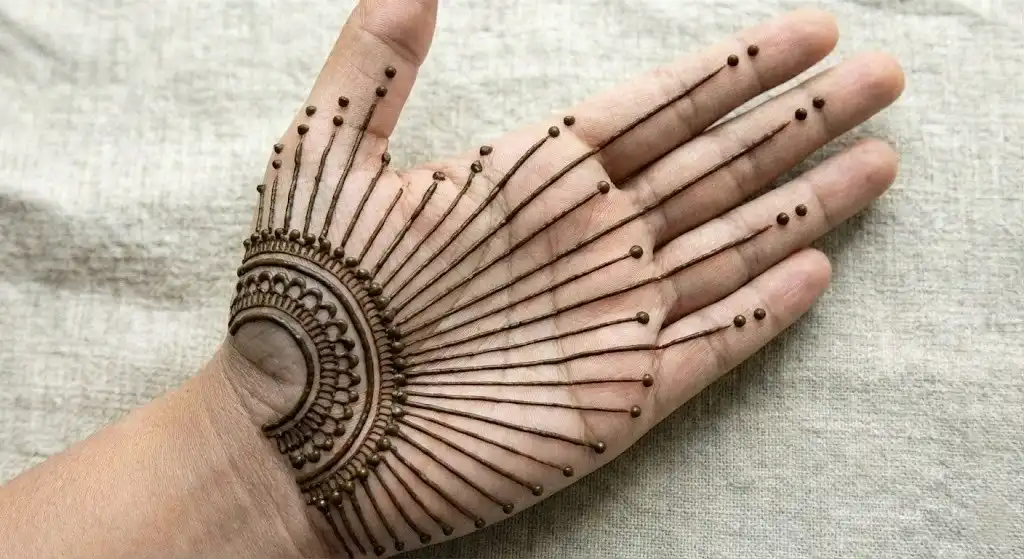
Artist’s Tip: Keep the “rays” thin. If the lines are too thick, it looks messy. Use the “draping” technique (lifting the cone) to get those long lines laser-straight.
Design 12: The Chevron
If you love geometric patterns, try this. It’s a tribal-inspired look using stacked zig-zag lines. It looks particularly good placed on the finger segments rather than the palm.
Step-by-Step:
- The Segments: Focus on the middle segment (phalanx) of each finger.
- The Zig-Zags: Draw 3 or 4 sharp zig-zag lines stacked on top of each other.
- The Triangles: You will see small triangles formed by the zig-zags. Fill every other triangle with solid henna.
- The Finish: Add a straight line at the top and bottom of the zig-zag stack to frame it.
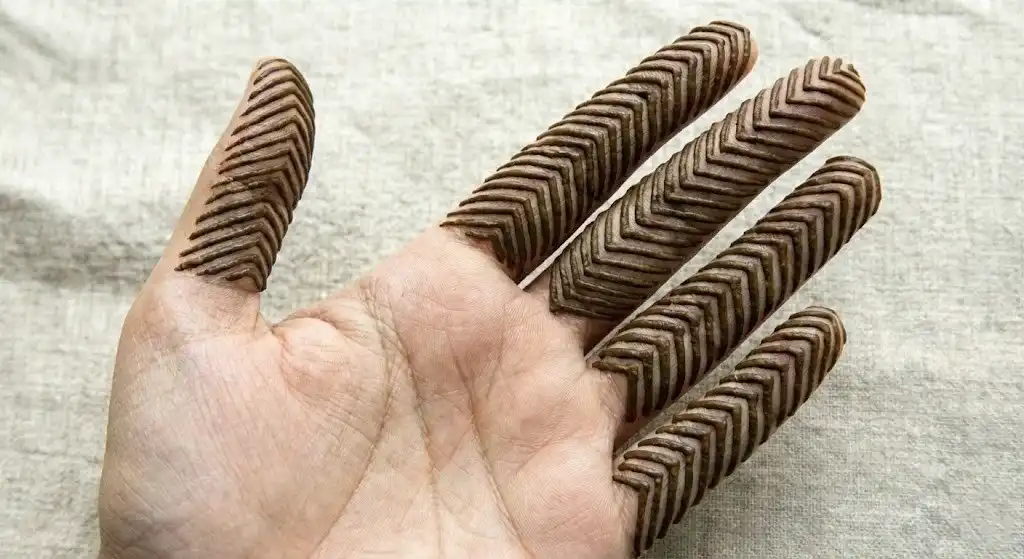
Artist’s Tip: Symmetry is key here. Try to make the “points” of the chevron line up with the center of your finger. It makes the fingers look slender.
Design 13: The Leafy Branch
Simple and nature-inspired. This is a horizontal design that crosses the palm, breaking away from the usual vertical vines.
Step-by-Step:
- The Stem: Draw a single, slightly curved line running horizontally from the thumb side of your palm to the pinky side.
- The Leaves: Add small, paired leaves along the entire length of the stem.
- The Buds: Add tiny dots at the very tip of each leaf to make them look like buds.
- The Flow: Make the leaves slightly smaller as you reach the ends of the branch.
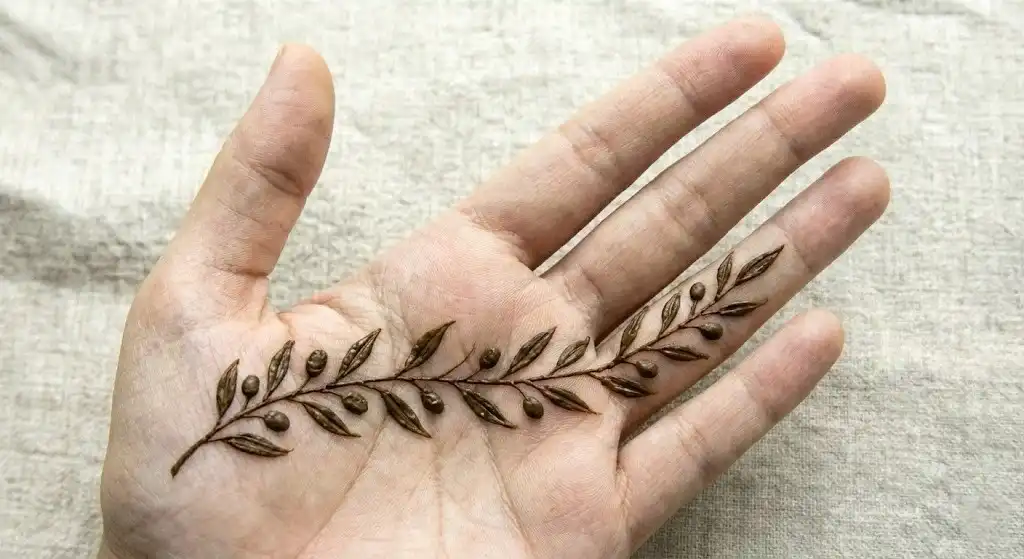
Artist’s Tip: Don’t draw the leaves flat. Curve them slightly towards the end of the branch. It makes the design look alive and moving, rather than stiff.
Design 14: The Paisley Cluster
The paisley (or “ambi”) is the most recognized henna shape. Instead of a big flowing trail, we create a cute “button” of paisleys in the center.
Step-by-Step:
- The Trio: Draw three small, plump mango shapes (paisleys) in the center of your palm, with their tails facing inwards.
- The Fill: Fill the inside of the paisleys with simple straight lines.
- The Gaps: You will have small empty spaces between them. Fill these with tiny swirls or dots.
- The Border: Thicken the outline of the paisleys to make them pop.
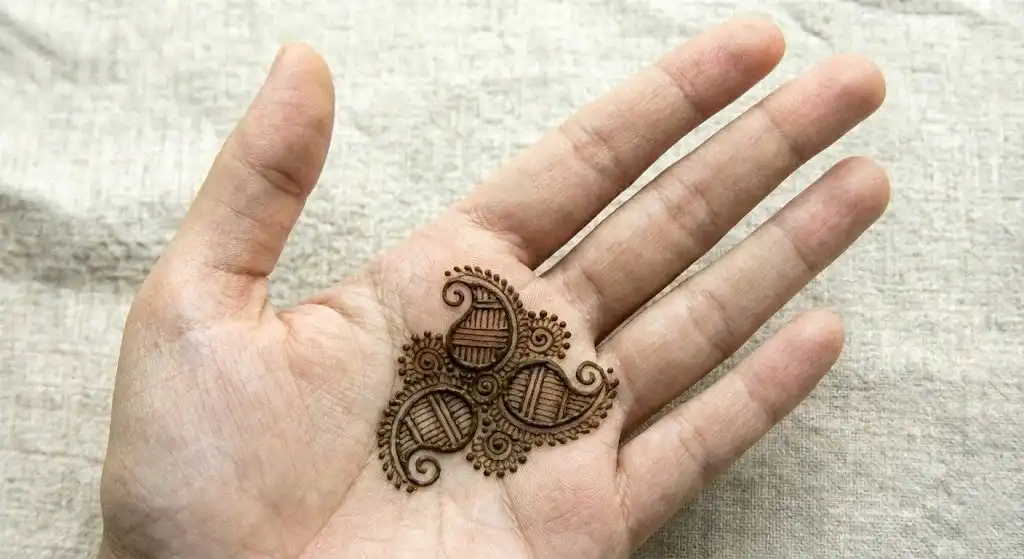
Artist’s Tip: The “tail” of the paisley is the hardest part. Don’t flick it too fast. Curl it in slowly so it looks round and cute, not sharp and spiky.
Design 15: The Name Design
Hiding names in mehndi is a wedding tradition, but writing a name (yours, or someone you love) in calligraphy as the main design is very special.
Step-by-Step:
- The Script: Write the name in the center of the palm. Use cursive or a stylized font. Make the down-strokes thick and the up-strokes thin.
- The Frame: Draw a circle or heart around the name using tiny dots.
- The Accents: Add a small flower or star at the beginning and end of the name.
- The Fingers: Keep the fingers completely bare so the focus stays on the text.
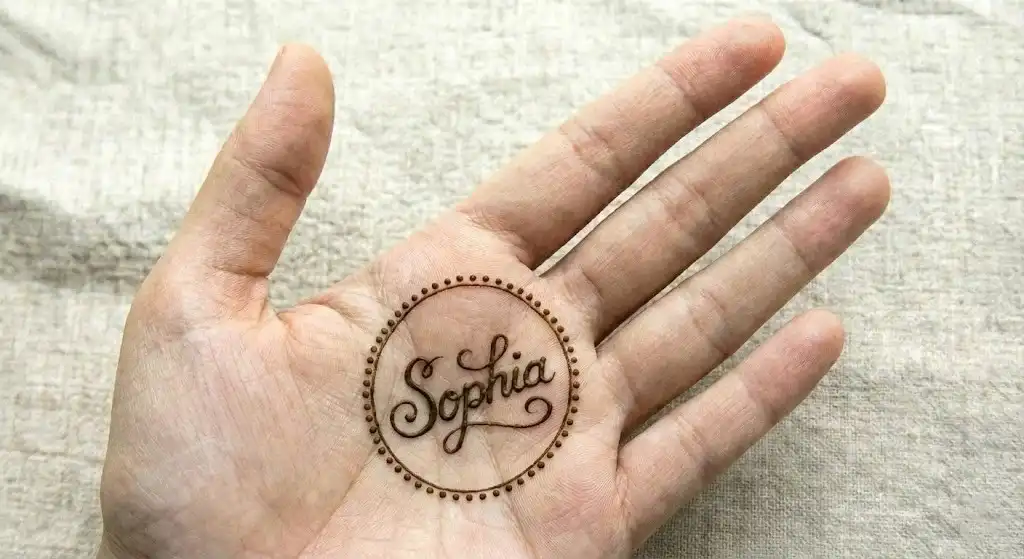
Artist’s Tip: Writing with a cone is harder than a pen because the paste spreads. Write the letters slightly larger than you think you need to, so they don’t blur together.
Design 16: The Coin
This is a bold, old-school traditional look often seen in rural folk art. It is striking because of the high contrast.
Step-by-Step:
- The Circle: Draw a perfect circle in the center of the palm (about the size of a coin).
- The Fill: Fill it solid with dark henna. Be generous with the paste so it stains very dark.
- The Halo: Draw a ring of small, neat dots around the solid circle. Leave a tiny gap between the solid circle and the dots.
- The Tips: Cap the fingertips solid to match the bold center.
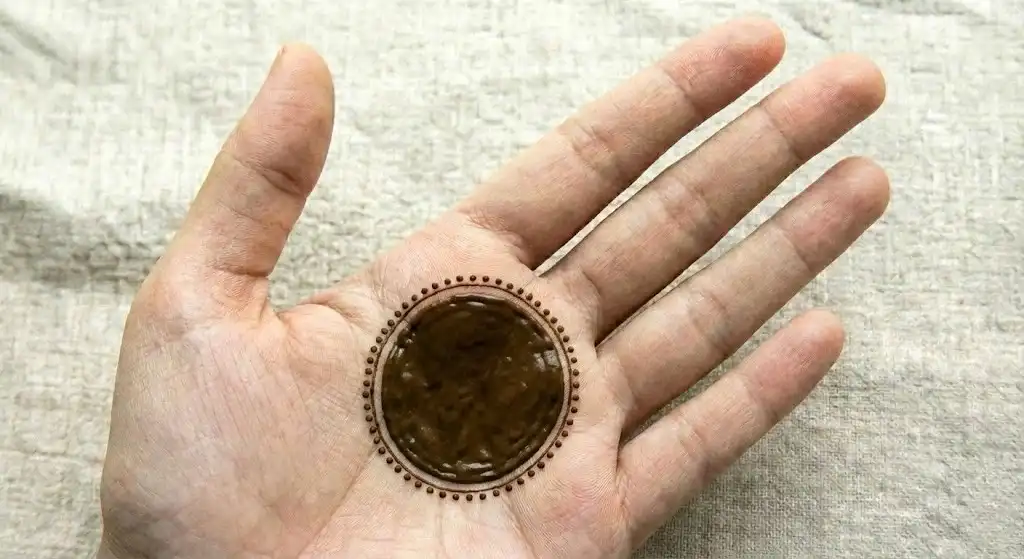
Artist’s Tip: When filling a large area solid, the paste can crack as it dries. Mix a little bit of sugar water into your paste or dab it on top to keep it flexible.
Design 17: The Raindrop
This is an abstract and flowing design that looks like movement. It is excellent for practicing your pressure control.
Step-by-Step:
- The Source: Start at the base of your fingers.
- The Drop: Draw a teardrop shape. Start with a thick dot and pull it down quickly into a thin tail.
- The Pattern: Draw rows of these drops falling towards the center of the palm. Stagger them like bricks in a wall.
- The Size: Make the drops smaller as they get closer to the wrist.
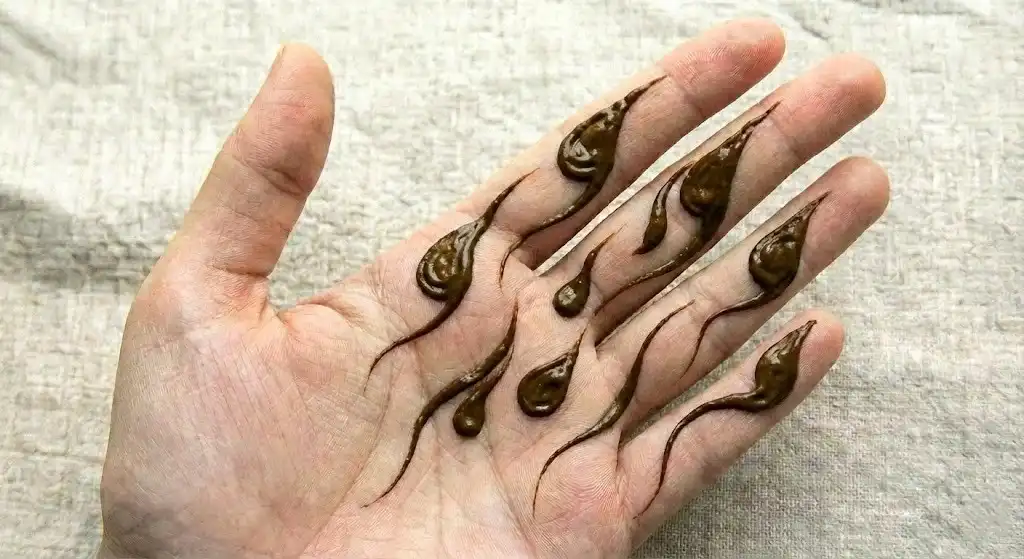
Artist’s Tip: This is the “Press and Pull” technique. Press hard for the round bottom of the drop, then lift and pull fast for the tail. Practice this on paper first!
Design 18: The X
Symmetry is naturally pleasing to the eye. This design uses cross-crossing vines to fill the space without being dense.
Step-by-Step:
- Line 1: Draw a simple vine from the bottom-left of the palm to the top-right (index finger).
- Line 2: Draw a matching vine from the bottom-right to the top-left (pinky finger).
- The Intersection: Where they cross in the middle, draw a small flower to hide the messy junction.
- The Balance: Keep the vines thin so the “X” shape is clear.
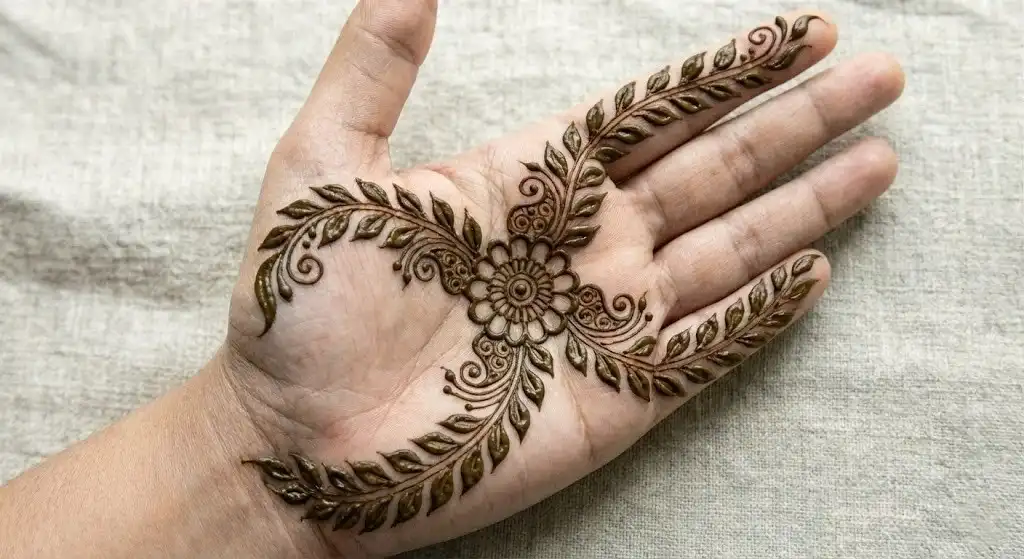
Artist’s Tip: Draw the main lines lightly first as a guide. Once you are happy with the “X” shape, go over it with your leaves and details.
Design 19: The Tips and Dots
The ultimate minimalist traditional look. This is often used for small children because it is fast, or for brides as a base layer.
Step-by-Step:
- The Caps: Squeeze a large amount of henna onto the top segment of each finger. Spread it to cover the entire tip (front and back).
- The Dot: Place one single, large, perfect dot in the exact center of the palm.
- The Wait: That’s it! The beauty comes from the deep red color of the fingertips, contrasting with the pale skin.
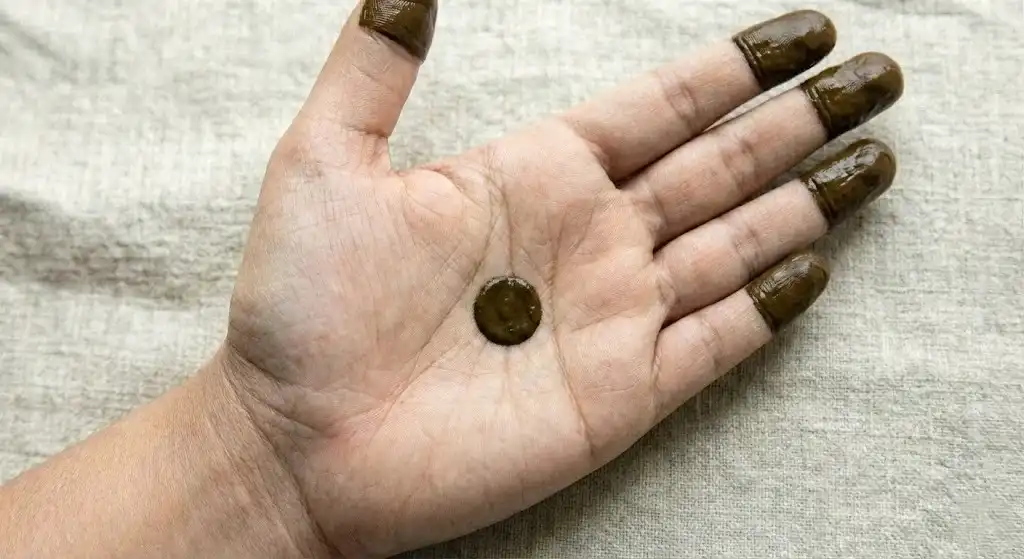
Artist’s Tip: This design relies 100% on the stain quality. Use fresh, natural henna. The fingertips will stain the darkest of any part of your body.
Design 20: The Abstract Line
For the artistic soul who doesn’t want flowers. This is modern art for your hands.
Step-by-Step:
- The Breath: Relax your hand.
- The Flow: Start at the wrist. Draw one single, thick, confident line that curves organically.
- The Path: Let it swirl once in the center of the palm and travel up to the tip of one finger (usually the ring finger).
- The Thickness: Vary the thickness, press harder on the curves and lighter on the straight parts.
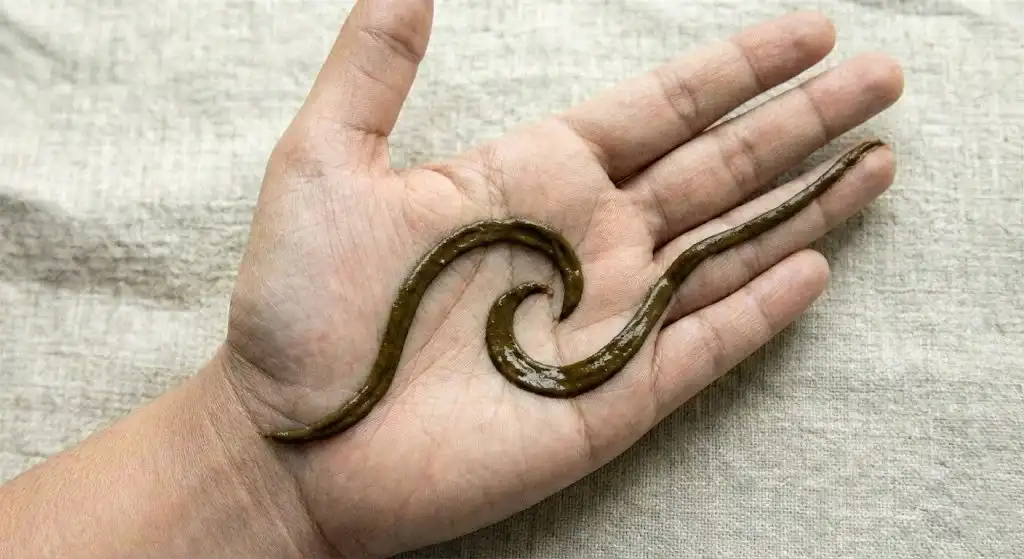
Artist’s Tip: Do not lift the cone. Try to do the entire line in one single, continuous flow. If you stop, you will get a bump in the line.
Aftercare: The “Dark Stain” Secrets
You’ve done the work. Now, don’t ruin it! The palm stains well, but you need to protect it.
- Lemon and Sugar: Once the paste is dry to the touch, dab a mixture of lemon juice and sugar on it. This sticks the paste to the skin so it keeps dyeing for longer.
- Clove Steam: This is an old artist trick. Heat a few cloves in a pan and carefully hold your hand over the smoke (be careful not to burn yourself!). The heat opens your pores and deepens the color.
- Avoid Water: This is the most important rule. Scrape the dried henna off with a butter knife or credit card. Do not wash your hands with water for at least 12 hours. Water stops the oxidation process.
Conclusion
Mehndi is supposed to be therapeutic, not stressful. Start with these easy front-hand simple mehndi designs, and don’t worry if your lines aren’t perfect.
Remember, once the paste falls off and the stain matures to that beautiful deep red, even the wobbly lines look artistic. Grab your cone, take a deep breath, and just let it flow.
Which of these 20 styles are you going to try first? I’d love to see your practice!
Frequently Asked Questions
Q1: Which mehndi design is easiest for beginners?
For absolute beginners, the Polka Dot style or the Central Mandala (Gol Tikki) is the easiest. These designs don’t require drawing long, straight lines, which requires steady hand control. They rely on simple shapes that look beautiful even if they aren’t perfect.
Q2: How can I make my front hand mehndi stain darker?
The palm is naturally the warmest part of the body, so it stains well. To make it even darker:
Leave the paste on for at least 6-8 hours (overnight is best).
Apply a mix of lemon juice and sugar once the paste dries.
Crucial: Do not wash your hands with water for 12 hours after removing the paste. Use oil to remove it instead.
Q3: Why do my mehndi lines look shaky?
Shaky lines usually happen for two reasons: holding the cone too tight or moving too slowly. Try to hold the cone near the top (not the tip) and move your hand faster. The faster you move, the straighter the line will be. Also, support your drawing hand with your other hand or the table.
Q4: How long do simple mehndi designs last?
On the palm (front hand), mehndi usually stains the darkest but also fades the fastest because we wash our hands constantly. A good natural henna stain will last 7 to 10 days. To make it last longer, wear gloves while doing dishes and apply coconut oil before showering.
Q5: Can I use black henna for these designs?
No, we do not recommend “Black Henna” (chemical dye). Real, natural henna is always green paste that stains orange-brown. Chemical black henna often contains PPD, which can cause severe burns and permanent scarring. Always use natural, organic cones.
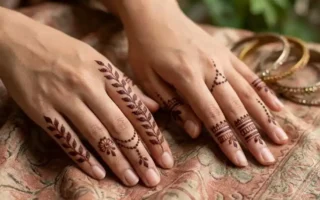
[…] Tip: If you are brand new to holding a cone, we recommend starting with our guide to Easy Front Hand Mehndi Designs to master your pressure control on the flatter palm […]